Our first daylight encouter with Krakow comes with a decision to tour by Hop Hop Bus. Via a tram, which only takes coins, which we don’t have, we fail to find one – but we do find an 8 seater golf buggy and its driver, Richard, which will take us round the three areas that make the city unique.
The electric cart takes on the old Jewish quarter first. Kazimierz was a city in its own right, and from the 15th Century up until 1941 it was home to Jewish families. Rich in synagogues, a market place, and monasteries, we weave round the streets which are, in winter, much quieter than the projected party image of the guide books would suggest. Here a former synagogue, there a home of Jewish poets, drones the pre-recorded guide Richard plays from his I-phone. And there is the remains of the old city wall………. We pass a large brick church which towers over the district – almost dominating the compact streets so well suited to our buggy. You want to go in? says Richard the driver – so we do.
It’s a gloomy morning, drizzle has kept our see-thru’ plastic sides rolled down, so we a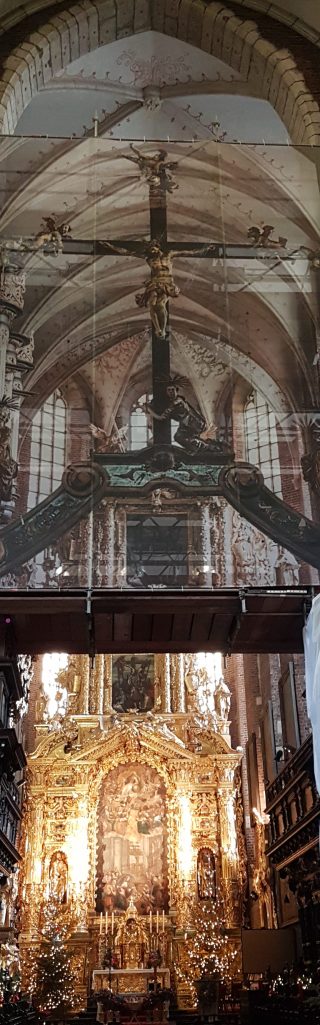 re surprised to find the east end of the building a blazing mass of gold. We are in Kozmierz’s parish church – Kosciol Bozega Ciala – or Corpus Christi Church, and a statement of Christian wealth and glory amidst this Jewish community that would be harder to equal. The body of the kirk is small – most English Parish churches would be larger, but it is wealthy, high and astonishing! One wall is stripped of its dark timbers, and underneath wall paintings of an earlier era emerge. A photo of its Central Crucifix hangs over the nave, the orginal absent for work or renovation, and almost escapes notice, so rich is the alter.
In a few minutes Richard deposits us at the last remaining operating Synagogue in the quarter. In contrast, it is small and modest – as befits the rules that govern Jewish houses of God. The women’s section modestly hides at the back behnd a lace curtain. It costs 10 zlotys each to enter, and nobody mentions the need to cover our heads, so we uncertanly remove our headgear. The collector listens to pop on his radio sips coffee, and nods us tolerantly in.
Outside, the Jewish cemetary is a place of pilgrimage, but we remain its sole visitors. Discarded fragments of gravestone form two “wailing walls”.
Before the War, 1/3 of Krakow’s citizens were Jewish. Only 8000 survived. Following their arrival in the city three days after the German invasion in Krakow in 1939, the Jewish population was evicted to the Ghetto on the other side of the Vistula. Nobody tells us what happened to the property stolen from its owners, though we know what happened to their lives.
Our 2nd city buggy destination is the Ghetto, which was instelf “liquidated” in 1943 when disease and starvation threatened the community. Nothing much remains, so our tour identifies where the gate where the “city” stood, and pauses at the main square, where stone chairs commemorate the furniture thrown onto the streets as the Nazis carried out their public health ethnic cleansing.
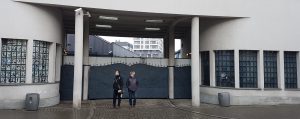 Round the corner, the buggy rattles up to Oskar Schindler’s famous factory, where 1500 jews were saved by his actions when he bought them from the SS – and though we stand outside and peer into the windows, we don’t go in. Richard gets up and fetches us leaflets from the museum desk inside. Nothing remains of the factory layout or machinery and the space is now a museum to the holocaust in the city.
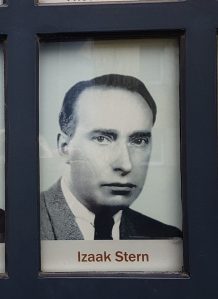 The photographs outside feature the Schindler Jews. Isaak Stern, his accountant – played by the charismatic Ben Kingsley in Spielberg’s Film – could be anyone – just as anyone could be sent to their deaths, and anyone could step into the role of executioner and torturer.
We conclude our tour with the Old city itself, which we have already walked through – its buildings are mercantile and commercial, and we are grateful that they seem to be home to restaurants that share the secrets of Polish cooking. It’s a pity only plumbers and builders come to the UK.
With that, we rush back to the hotel – to meet our fate in the Krakow saltmines in the afternoon.

